Call Now — Written Pricing (403) 555-0100

Bathroom Mould Removal in Lethbridge

Ceiling corners, grout lines and tub surrounds that keep regrowing — treated with the ventilation fault that causes them, not just wiped down and repainted.

The Room That Keeps Rebuilding Its Problem

Bathrooms are the smallest rooms in a Lethbridge house and the largest share of the regrowth we are called into. The reasons are structural. This city's water arrives already heavy in minerals, so grout and caulk lines rough up faster and hold grit that films over with soap residue — a growth bed, not a smooth wall. Houses here are sealed tight through cold snaps and chinook swings alike, and showers push a cloud of vapour into a room whose ceiling corners run cold all winter. And the exhaust fans in much of the city's housing are either undersized for the room or discharging somewhere nobody intended — a soffit, an attic bay, a duct that fell off the roof cap in a winter windstorm.

Cleaning is fine maintenance; it is not remediation. Spraying the ceiling corner each month is a treadmill, because the cycle that produces the stain — steam, cold surface, trapped air — runs daily and the ventilation that should break it is the broken part.

Our bathroom work reads the room first: airflow at the fan, the actual discharge path, wall cavity condition behind the toilet and along the tub's exterior wall. Removal is contained where demolition happens, surfaces are treated, and the report puts the ventilation correction in writing so the room stays dry after we leave.
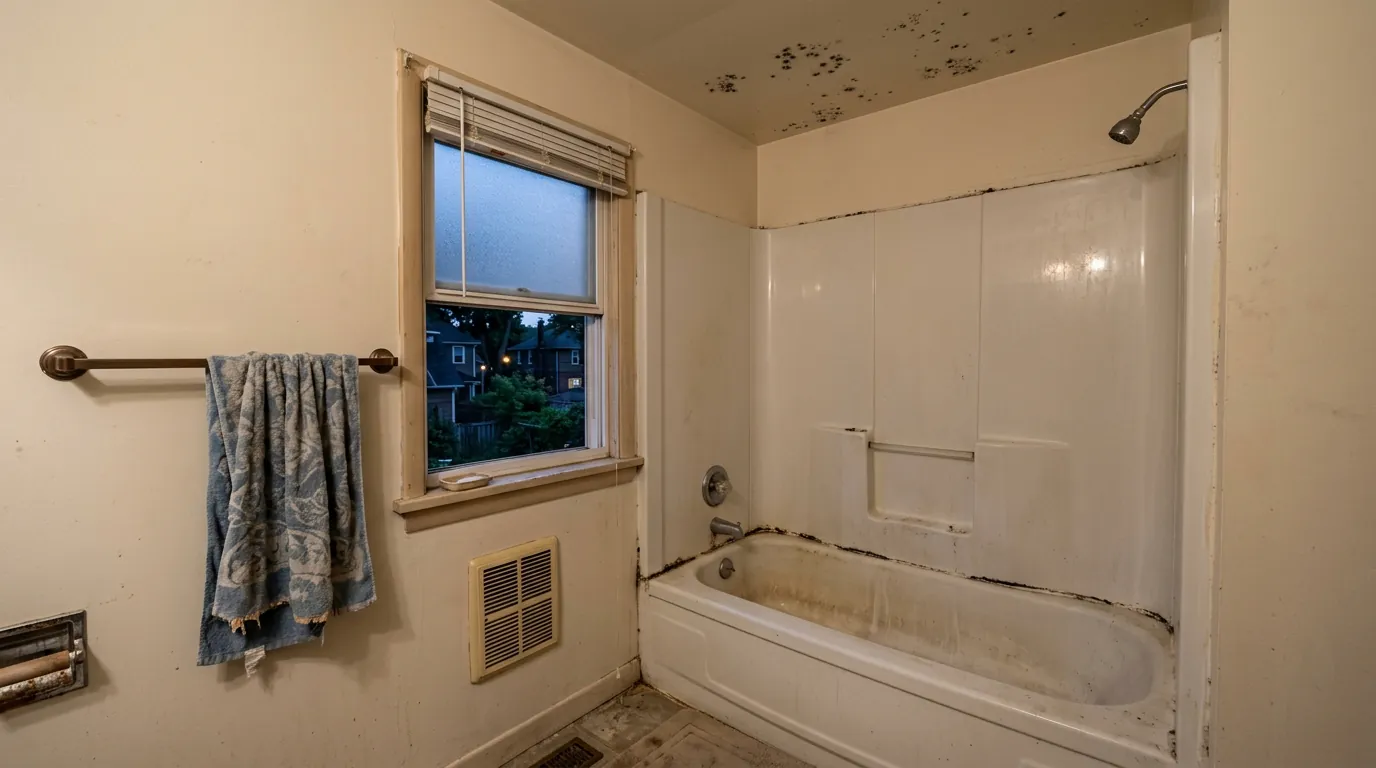
Mould spotting across the ceiling and tub-surround seams of an older Lethbridge bathroom

Where Bathroom Growth Concentrates

When two or more of these are active, chances are the discharge path is the root cause — that is the first thing our inspection verifies, and correcting it is what makes removal stick.

Bathroom Mould FAQs

Why does bathroom mould keep regrowing in the same ceiling corner?

Two Lethbridge causes stack. First, moisture: showers in a house that is sealed tight through cold snaps push steam up, and ceiling corners are the coldest, least-insulated spot in the room, so vapour condenses there overnight. Second, ventilation: many bathroom fans are either too small for the room or, worse, discharge into the attic space instead of through the roof cap. Clean the ceiling without changing the airflow and the same corner regrows — usually by the next cold spell.

Is bathroom mould dangerous, or just ugly?

Small patches on grout or painted ceilings are a maintenance problem, not an emergency — clean them with soap and water and keep the fan running. The warning signs are different: growth that returns within weeks of cleaning, spreads beyond a single corner, appears on drywall behind the toilet or along the tub's exterior wall, or comes with a musty smell you cannot source. Those patterns usually mean moisture is entering the wall or the ceiling cavity, where the real colony lives.

Should I caulk over mouldy grout?

No. Sealing growth inside a fresh bead of caulk hides it while keeping its moisture supply, and the resulting sandwich usually shows as staining or bubbling within a year. Strip the affected material, treat what remains, dry the wall behind it, then re-caulk on a clean surface — and confirm the fan actually pulls air, because moisture management is what makes the caulk last.

Does my bathroom need a bigger exhaust fan?

Often, yes — but discharge matters as much as capacity. A fan rated for the room that dumps into the attic moves the problem upstairs, where it condenses on winter sheathing and feeds ceiling-cavity growth. We check both: air movement in the room and the full duct path to the roof cap. The fix is usually modest — a correctly sized fan ducted outdoors, run for twenty minutes after showers.

Do you handle the ceiling and the fan together?

Yes — that pairing is the point. Removing ceiling growth while the fan keeps blowing damp air into the same cavity would leave you regrowing the colony next winter. Jobs on this page remove the growth, treat the surface, document the discharge path we found and the ventilation correction needed, so the fix holds.

← Back to the Lethbridge home page  |  Mould inspection, explained →  |  Attic mould removal, explained →

Stop Scrubbing the Same Ceiling Every Month

A fifteen-minute call traces the fan, the duct and the wall cavity. Get the pattern fixed, not repainted.

(403) 555-0100