Call Now — Written Pricing (403) 555-0100

Mould Remediation & Your Home Insurance in Alberta

An educational guide for Lethbridge homeowners: how insurers treat water and mould claims, and how to document a job properly — from a remediation company, not an adjuster.

The Cause Decides Everything

Ask two homeowners in the same Lethbridge neighbourhood what their insurer did about mould and you can get opposite stories, and both be true. The difference is rarely luck; it is the cause of the water and how the policy words it. Alberta home policies generally respond to sudden and accidental escapes of water — a supply line that bursts overnight, a hose that splits on a Saturday. They generally do not respond to the slow kinds: years of condensation on a poorly insulated wall, seepage through a foundation that has been damp every spring for a decade, a bathroom fan that has been missing its duct for as long as the family has owned the house. Growth that follows excluded water is usually excluded with it.

Between the two sit the endorsements. In Alberta, sewer backup and overland water are commonly add-on products — you have them or you do not, and the wording varies by carrier. Chinook-belt basements see all three mechanisms in a single winter: a burst line in January, a melt-pulse seep in February, a main backup in March. Which ones your policy answers to is worth reading before you need it, not after.

One boundary this page will not cross: nothing here is coverage advice, and no remediation company can decide what your insurer owes you. Decisions belong to you, your broker and your adjuster. What a remediation company can do is produce documentation so unambiguous that those conversations are short. That is the purpose of this page.
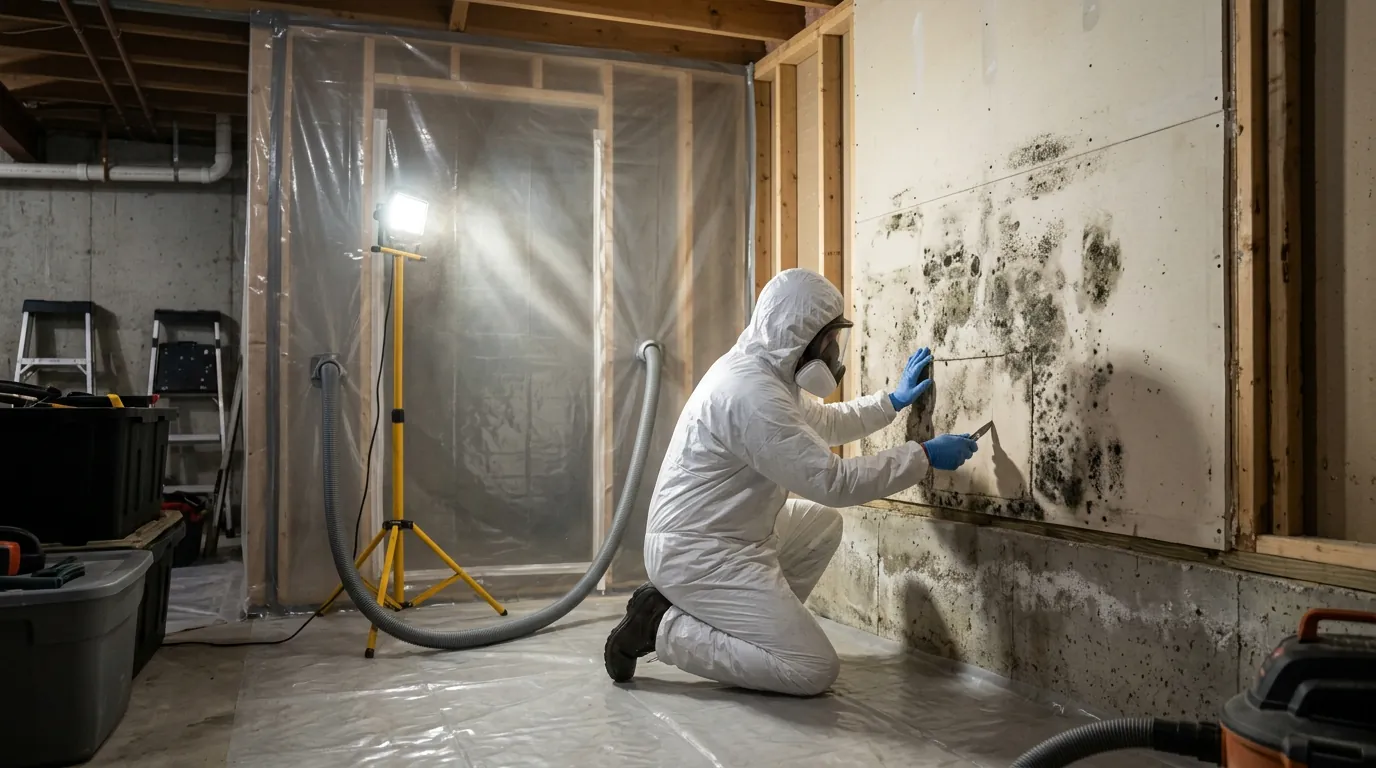
Removal technician working behind sealed plastic containment as part of documented remediation work

The Sequencing Mistake We See Most

Water enters a basement during a January melt. The family tears out the wet carpet and the base of the drywall that weekend, hauls it to the dump, and calls the insurer on Monday. Nothing about that instinct is wrong for the house — dry quickly, absolutely — but for the file it can be costly: demolition removes the materials, the readings, and the cause evidence the adjuster would have worked from, and reconstruction without records invites questions the file cannot answer.

The sequence that serves both house and file: (1) stop and extract where safety allows; (2) photograph everything wet, everything stained, everything failed; (3) dry aggressively with dehumidifiers and air movers, for days not hours, and keep an equipment log; (4) call the insurer and get direction before structural demolition; (5) once agreed, open, document, and scope the remediation in writing. Our inspection report is written to slot into step four — causes, readings, images, and a priced scope the adjuster can read as-is.

Frequently Asked Insurance Questions

Does Alberta home insurance cover mould removal?

It depends almost entirely on the cause of the water and the wording of the policy. Mould that follows a sudden, accidental escape of water — a burst supply line, a split washing machine hose — is often handled under the same claim as the water damage itself. Mould from gradual seepage, long-term condensation, or deferred maintenance is normally excluded, because the policies treat it as a maintenance outcome rather than an accident. Sewer backup and overland water are endorsement products in many Alberta policies; whether mould cleanup carries those caps is a question for your own policy documents.

Why should I call my insurer before tearing anything out?

Because sequencing decides a lot of outcomes. Emergency water extraction and drying are usually expected immediately, but demolition beyond that is expected only when the adjuster has inspected or agreed. Tearing out a wet wall first thing can remove the evidence the claim rests on — the readings, the failed materials, the cause — and that is how otherwise-valid claims get complicated. Dry, document, photograph, then open walls when it is agreed.

What documentation helps a mould claim?

The plain kit: dated photographs of the water and of anything already stained, the source repair receipt where there is one, moisture meter readings and thermal images, the written inspection report identifying cause, and the remediation scope with its price in writing. Keep drying records — equipment lists, days run, readings taken. Adjusters reconstruct events from chains like this; a claim with a clean paper chain moves faster than one reconstructed from memory.

Is it worth claiming small mould jobs?

That is a decision for you and your broker, not for your remediation company. The general considerations are the deductible against the cost, the claim history effect some insurers price on, and whether the cause is even of a type the policy responds to. For small contained patches many households pay directly and simply keep the paperwork. What matters in every case is that the work is properly done and documented, whoever pays for it.

Do you bill insurance directly?

No. We are remediation specialists, not a claims administrator: you pay us and claim against your policy if the coverage and your insurer's process allow it. What we do provide is the documentation set insurers work from — inspection report, readings, photographs, scope and a written quote — so you can have the conversation with your adjuster on solid ground. Coverage decisions belong to you and your insurer; our job is to make the facts unambiguous.

← Back to the Lethbridge home page  |  Mould removal services, explained →  |  General mould FAQs → - all questions

Documentation Starts With the Inspection

Causes, readings, images and a written scope — the file an adjuster asks for, ready before you need it.

(403) 555-0100