Removal That Answers the Cause, Not Just the Colony
Ask what actually failed in most Lethbridge remediation jobs and the answer is rarely the cleaning. It is the sequencing. A wall gets scrubbed, the stain disappears, and everyone moves on — while grading still tips toward the foundation, the downspout still dumps at the corner, and the attic still holds a hundred-year-old venting mistake. Then the chinook thaw returns in January, the same assembly gets re-wetted, and the growth resumes exactly where it stopped. A removal project earns its cost only if it closes the moisture story in the same visit.
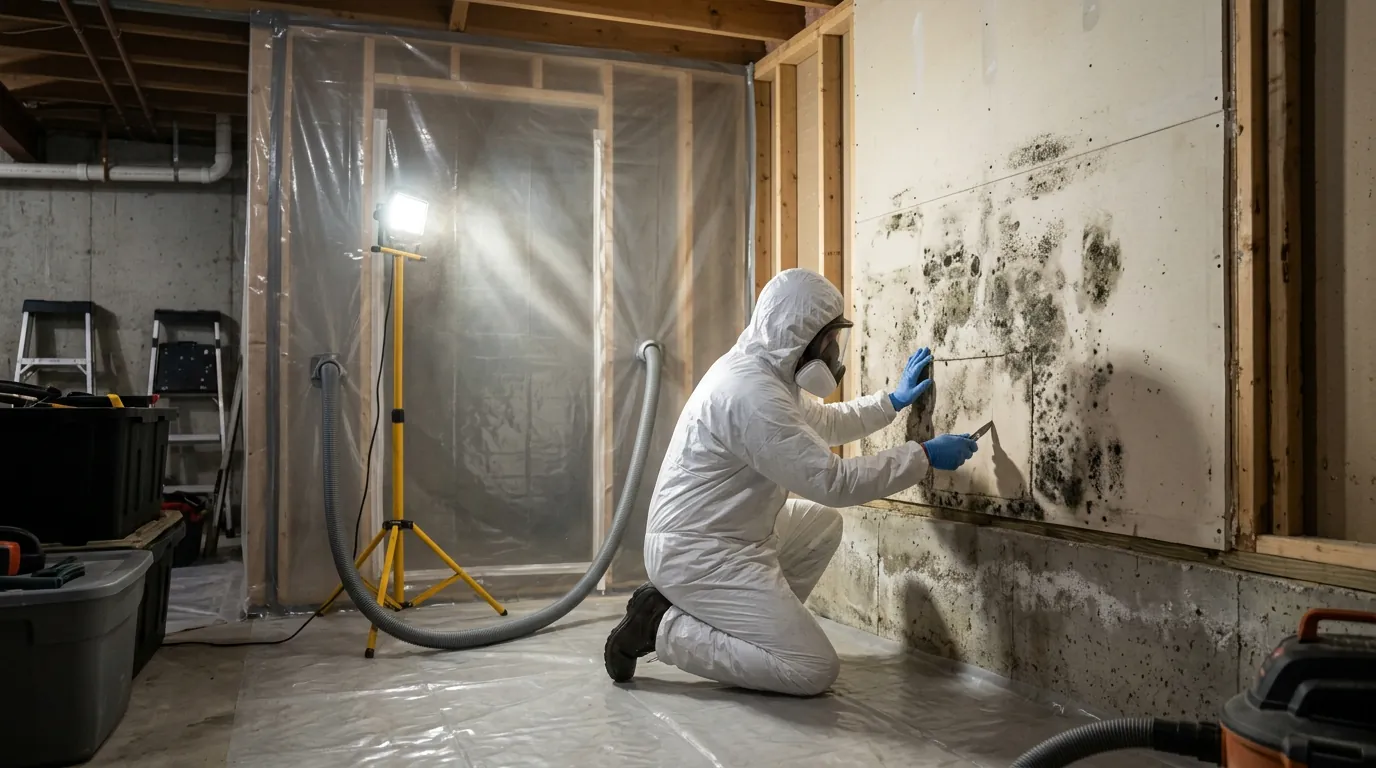
Our sequence is disciplined about that. Everything opens with an instrument pass — thermal imaging and moisture meter readings that fix the boundary between the colony you can see and the moisture it is drinking from. Containment goes up before a single cut: poly sheeting, negative air pressure, HEPA scrubbers running from the first strip of drywall to the last bagged-out load. What is gone is gone — porous materials are removed and sealed out, surfaces that remain are cleaned under HEPA capture and treated with antimicrobials, and structural wood is refinished back to clean stock.
The final stage is documentation: verification that airborne spores have returned to a normal background range, plus a written cause note covering the grading, venting or envelope path that produced the growth. Keep that paper. It is the record a future buyer, contractor or adjuster will want to see, and it is the checklist that keeps the wall from quietly rebuilding the problem.